
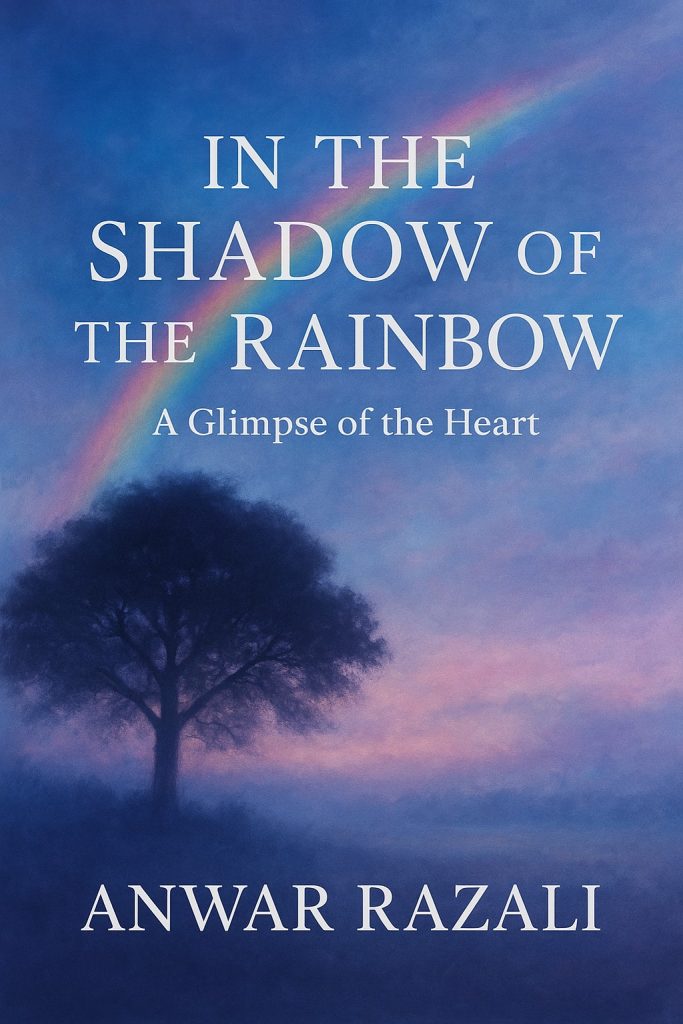
PREFACE
A Glimpse of Feeling
Originally, Lelaki di Sebalik Pelangi — The Man Behind the Rainbow — was a true confession of a man entangled in a world deemed not normal. I interviewed Brian, listened to his story, and reworked it into a narrative suitable for the public. The story was first serialized in a weekly magazine where I worked, under the title Jejak-Jejak Pondan (Traces of the Effeminate).
From its title alone, one could already sense the nature of the confessions. As a journalist, I must admit that Brian’s revelations were controversial — and undeniably compelling. They drew readers to follow his life, week after week. In truth, his story was far more intense than what I dared to print. I had to reshape his confessions carefully, ensuring they could be accepted by the public while keeping the core truth intact.
Many readers pleaded for the continuation of the series after I ended it abruptly following several months of publication. They wanted to know what became of Brian — and of the others whose lives intertwined with his.
For a long time, I kept this manuscript, editing and refining it repeatedly. The desire to publish it in physical form had always been there, though I waited for the right time. And perhaps that time has finally come.
While completing this manuscript in 2022, our society was confronted with a surge of discussions and movements surrounding the LGBT agenda — some led by groups with certain interests. Thus, I believe this is the right moment for us to read with open minds and compassionate hearts.
I am not saying that what Brian and the other characters experienced should be celebrated or emulated. Yet, I am fully aware that such issues are no longer secrets to be hidden. What I have presented here is but a small window into the turbulence within that world.
As Brian once asked me to include guidance and reflection within his story, I have done my best to weave those elements into the narrative. I am merely using what little gift I have — the gift of storytelling. It may not match the brilliance of other writers, but my strength lies in observing, feeling, and sharing. And from that came Lelaki di Sebalik Pelangi.
Inspired by a true story, I have, of course, changed the names and identities of all characters, to preserve their dignity and privacy. So, do not ask who they are or where they are now. Let the ending I have written serve as the answer.
For in life, every soul is tested — again and again. Existence is a long journey of struggle, winding through the sweetness and bitterness of human experience. Such is the truth of living. Yet, no matter who we are, no matter where we have been — in the end, we all return to the One. The Most Compassionate. The Most Forgiving.
Ameen.
With sincere regards,
Anwar Razali
A Lonely Heart’s Reflection
“My life has been filled with too much bitterness.
I’m not sure if there’s still a light of happiness waiting for me tomorrow.”
Truly, no one in this world wishes for misfortune.
No one willingly walks down a path that strays from what is called normal.
If we were given the freedom to choose, surely we would all reach for perfection — for happiness as the meal of life.
Even when hardship or calamity strikes, we tell ourselves that it won’t last forever. We continue to hope, continue to pray, that joy will return at the end of it all.
Yet, in the pursuit of a flawless life, whether we like it or not, some of us are destined to wander through darker worlds — worlds stumbled upon by coincidence, or perhaps decreed by fate.
What begins innocently can, in time, take a turn that no one expected — until returning becomes impossible. And so, one learns to live with sorrow, in the confusion of a life that has lost its compass.
When temptation and desire overpower reason, repentance remains only a whisper in the heart.
The wish to change never becomes action.
The will to leave is restrained by invisible chains.
Such was Brian’s life — a maze of pain that many would never imagine walking through.
But that, indeed, was his reality.
No matter what others thought or said, Brian didn’t care.
People could talk, he told me.
But only he bore the suffering.
Only he lived it.
“If I’d cared about what people think,” Brian began softly,
“I would have died long ago.”
“We live not by others’ opinions,” I replied, taking a breath.
“Black or white, it’s our own hands that paint our lives.”
“But isn’t it people’s judgment that traps us?” he countered.
“You do one thing — you’re wrong. You do another — still wrong.
You live every day under someone’s gaze, and it crushes you inside.”
“I don’t fully agree,” I said gently. “People can have their opinions, that’s their right.
But in the end, the choices are ours to make.
Like I said — our life’s canvas, its dark and light shades — we decide them.
We all sin, yes, but the door to repentance always remains open, doesn’t it?”
Brian smiled faintly. “Beautiful words. But in my case… it’s not that easy.
As they say, the burden on the shoulders hurts more than the pity in the eyes.
You can’t feel my pain by just watching it.”
“Still, you have the right to choose between what’s good or bad.
So why live by others’ standards?
As long as you know who you are — that’s enough,” I said, hoping to console him.
Though we had only spoken twice before — once on the phone and now, face to face for the first time — Brian was strikingly warm. His friendliness came easily, his words natural, as if we’d known each other for years.
He preferred the casual “aku” and “engkau” when speaking with me — perhaps it was just his way of connecting. I didn’t mind.
I felt, somehow, that meeting Brian was not something that should pass me by.
We met at his home — a corner-lot two-storey terrace in an upscale Petaling Jaya neighborhood.
The house reflected him completely — neat, refined, and minimalist.
White dominated everything — the furniture, the walls, even the curtains — with just a touch of red roses brightening the corners.
“I like white,” Brian explained, catching my curious gaze.
“It makes everything look pure, open, and calm.”
I nodded, admiring the space — it wasn’t just clean; it carried a scent of roses, soft and calming.
“I used to love bright colors — red, green, yellow, even black,” he continued.
“Every corner looked like a studio, vibrant and stylish. But it got tiring.
A home should soothe you after long days at work, not overwhelm you.
White feels peaceful. It feels… forgiving.”
As an interior designer, his touch was impeccable. Even the smallest detail carried intention.
Everything harmonized perfectly — the mark of someone who understood beauty and pain equally well.
Brian invited me to sit in the living room.
From where I was, I could see the whole decor — an elegant fusion of simplicity and soul.
I complimented his taste. He smiled widely — perhaps used to such praise.
After all, as a designer, this house was both his sanctuary and his showcase.
Our acquaintance began unexpectedly — with a blue envelope left on my desk.
At first, I thought it was one of the many letters we received at the magazine — usually from women sharing their experiences, struggles, or heartbreaks.
But this one was different.
The handwriting was bold, the tone personal. It was addressed directly to me.
When I read it, I knew — this was no ordinary story.
I called him, and soon after, we arranged to meet.
That rainy Sunday morning, I sat in Brian’s living room with a plate of nasi lemak and a cup of hot Nescafé. The rain outside softened the air — the perfect backdrop for a heavy conversation.
“If I could choose,” Brian began again, “I’d still want to live like everyone else —
to marry, to have children.
But I don’t think that’s ever going to happen…”
“That’s the voice of despair, Brian. Don’t let yourself give up — Allah dislikes hopelessness,” I reminded him gently.
He chuckled softly. “Hopeless? I’ve been hopeless for years.
What’s left now is just waiting… waiting for Allah to call me back. I’m ready.”
“Do you feel that time is close?” I asked, sipping my coffee.
“Everyone dies,” he replied calmly.
“The only difference is — I think my time might come sooner. Because of what I’ve done.”
That morning, Brian wore a pink shirt and black palazzo pants. His long hair fell past his shoulders. His skin was flawless, his manner elegant. Despite his sadness, there was still grace in his presence — the kind that comes from years of hiding pain behind beauty.
“Even people with terrible illnesses live long lives, Brian,” I said.
“And sometimes, the healthy ones go first. We never really know, do we?”
He smiled weakly. “I hope I can think like you do.”
“You can,” I replied. “Insha’Allah.”
Then, almost in a whisper, he said again —
“My life has been filled with too much bitterness.
I don’t know if happiness will ever find me again.”
“Maybe this story — your story — will help others understand,” I told him.
“People often judge what they don’t understand.
If they can’t sympathize, at least they’ll learn something. About compassion. About acceptance.”
“I just want to share it,” Brian said. “Not to glorify it.
Take the good as lessons. Leave the bad behind.”
I smiled, understanding the courage it took for him to say that.
It’s never easy to expose one’s past — especially one that society refuses to understand.
Then Brian looked up at me, his eyes searching.
“Do you think people like me can ever be forgiven by Allah?
Do you think there’s still a place for me in heaven — beside our Prophet?”
I didn’t answer.
We both fell silent.
Outside, the drizzle continued, washing the world in grey.
Inside, the quiet between us was heavy — as though Brian’s heart carried a storm no one else could weather.
That morning, the chill of the rain wrapped around our words —
and for the first time, I truly saw the sorrow behind Brian’s gentle smile.
Behind his laughter lived a man aged forty-two, burdened with memories that bled quietly within.
And that… was the beginning of Brian’s story.